Must-Try Turkish Coffee: A Small Cup, a Lasting Taste of Istanbul
Discover Turkish coffee through its rich aroma, distinctive brewing method, and social traditions—with Istanbul stops in Beyoğlu and Kadıköy, plus a historic coffee souvenir shop.
 Burak ÇınarTurkTravelRadar Founder
October 1, 2026
The cup is smaller than you expected.
A fine layer of foam rests on its dark surface. Beside it sits a glass of water, perhaps with a piece of Turkish delight waiting on the saucer.
Lift the cup by its handle. The porcelain is warm, and the aroma reaches you before the first sip: roasted coffee, deep and inviting.
Wait a moment, then taste.
The coffee has a full, almost velvety body. Its flavour lingers, encouraging a slower second sip. Around you, cups return to saucers with a quiet clink, and someone continues a conversation that began long before your order arrived.
This is Turkish coffee, a drink that gives you a good reason to sit down—and stay a little longer.
What Makes Turkish Coffee Different?
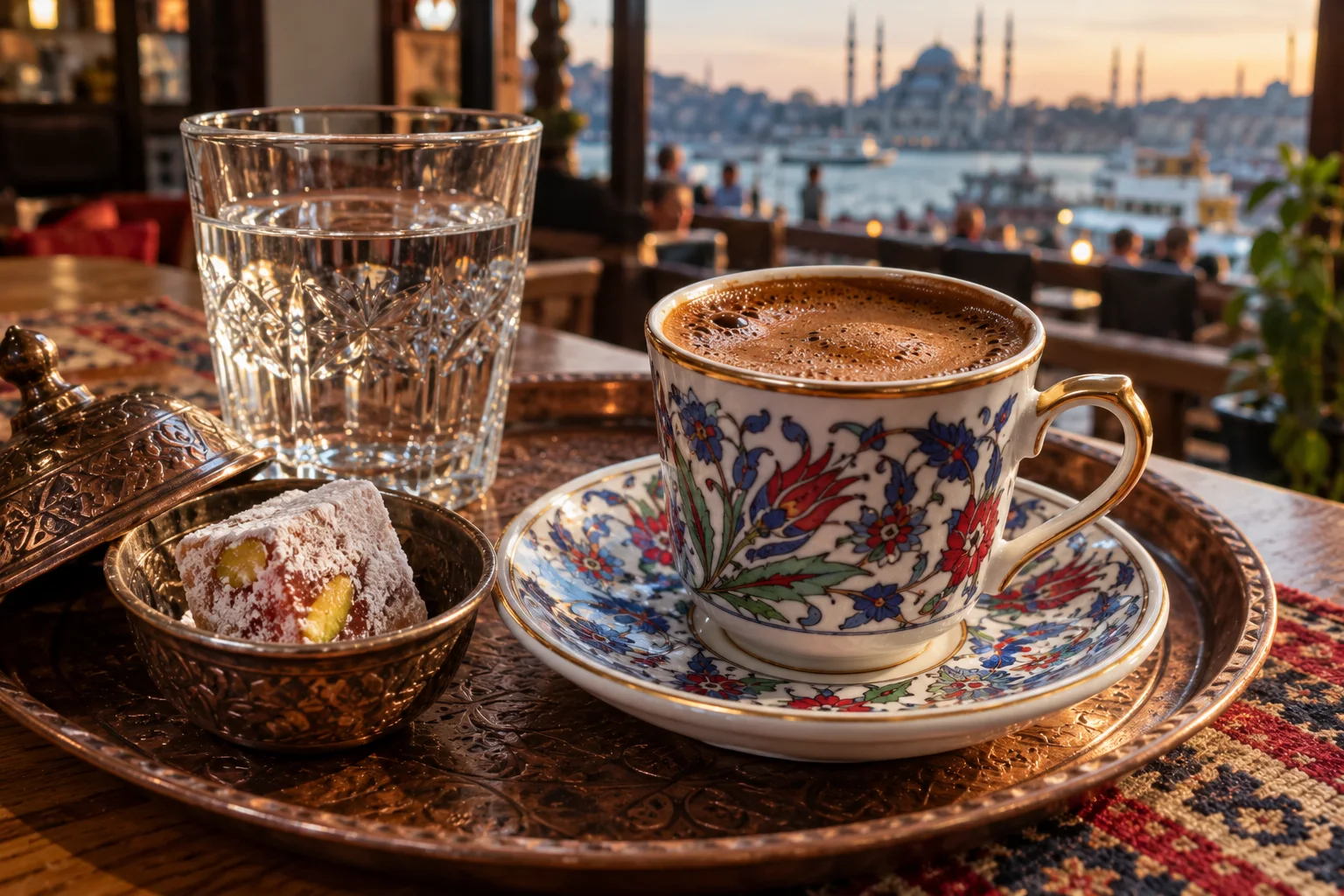
Turkish coffee is a method of preparation, rather than a coffee bean grown in Turkey.
Finely ground coffee is heated with water in a small pot called a cezve. Sugar, when requested, is usually added during preparation.
The coffee is served unfiltered in a small cup. As it rests, the grounds settle toward the bottom.
That gives the drink its distinctive body and changes how you enjoy it. Take small sips, avoid stirring the cup, and leave the thick sediment behind.
You do not need to finish every drop.
The First Sip Deserves Your Attention
Begin with the aroma.
Depending on the beans and roast, you may notice nutty, chocolate-like, or more deeply roasted notes. Different cafés use different blends, so one cup can taste noticeably different from another.
Then notice the texture.
Turkish coffee feels fuller than a filtered brew. The fine particles contribute body, while a well-prepared cup can still feel smooth enough to sip comfortably.
The foam adds another visual pleasure: a delicate brown surface that shifts as you lift the cup.
Drink slowly enough to notice how the flavour changes as it cools. A sweetness or aromatic detail that was difficult to identify in the first hot sip may become clearer a few minutes later.
A Coffee Tradition Recognised by UNESCO
In 2013, Turkish coffee culture and tradition was inscribed on UNESCO’s Representative List of the Intangible Cultural Heritage of Humanity.
The recognition embraces the preparation of the drink and its social role: hospitality, friendship, conversation, and occasions when people gather.
That helps explain why a small cup can occupy so much time.
At a table, the coffee gives a conversation room to develop. During a visit, offering it can be a gesture of welcome. For a traveller, it provides a natural pause between the places you came to see.
You order a drink, but you also make space in your day.
Choose Your Sugar Before the Coffee Is Made
Your server may ask how sweet you want it.
The familiar choices are:
- Sade: no sugar.
- Az şekerli: lightly sweetened.
- Orta şekerli: medium sweet.
- Şekerli: sweet.
The exact sweetness varies between kitchens.
For a first tasting, sade lets you concentrate on the coffee itself. If you normally enjoy sweetened coffee, az şekerli may be a comfortable introduction.
Tell the server when ordering. Adding sugar afterwards requires stirring, which disturbs the grounds settling in your cup.
Where to Drink Turkish Coffee in Istanbul
Mandabatmaz — A Coffee Stop off İstiklal Avenue
Mandabatmaz is a strong choice for travellers who want to make Turkish coffee the focus of their break.
The small Beyoğlu coffee shop is particularly associated with its dense foam and has been featured in the district’s official gastronomy coverage.
Its name is commonly explained as suggesting that even a buffalo would not sink—a playful reference to the coffee’s thick foam.
Why visit? For a dedicated Turkish-coffee experience that fits naturally into a walk along İstiklal Avenue.
Look for Olivia Geçidi Çıkmazı No. 1/A, Beyoğlu, off the main avenue. Find a seat if one is available, order your preferred sweetness, and let the cup become the reason you stop.
Use Mandabatmaz’s official website for contact details and packaged coffee; the site also operates as an online shop, while the address identifies the physical café.
Fazıl Bey’in Türk Kahvesi — A Pause in Kadıköy
Fazıl Bey’in Türk Kahvesi offers another appealing setting for discovering the drink, this time in Kadıköy.
The business has received independent coverage of its coffee-shop story and its connection with the neighbourhood’s market life.
Why visit? To make Turkish coffee part of an outing through Kadıköy’s food-shopping streets, with time to sit and enjoy a cup between stops.
Seek out the Kadıköy market-area location and check the official website for current branch details before travelling.
This is an opportunity to compare cups, too. If you have already visited Mandabatmaz, order the same sweetness and notice the differences in aroma, roast, body, and finish.
A Coffee Souvenir from Eminönü
If you want to take the experience home, consider Kurukahveci Mehmet Efendi, whose history dates to 1871.
Its historic Eminönü shop is a coffee-buying stop to pair with an exploration of the Spice Bazaar area.
Choose ground Turkish coffee if you plan to prepare it in a cezve. The very fine grind is part of the method.
Treat this as a shopping stop rather than assuming it offers the same seated café experience as the places above.
A packet of coffee is easy to carry home. More importantly, it gives you a reason to repeat the ritual after your journey.
How to Order Turkish Coffee
For an unsweetened cup:
“Bir sade Türk kahvesi, lütfen.”
One Turkish coffee without sugar, please.
For a lightly sweetened cup:
“Bir az şekerli Türk kahvesi, lütfen.”
One lightly sweetened Turkish coffee, please.
For medium sweetness:
“Bir orta şekerli Türk kahvesi, lütfen.”
One medium-sweet Turkish coffee, please.
Take a little water before your first sip if you wish. It helps you approach the flavour with a fresh palate.
Then allow the coffee to settle and cool enough to drink comfortably.
What About Coffee Fortune-Telling?
You may see someone place a saucer over an empty cup, turn it upside down, and wait.
In kahve falı, coffee fortune-telling, the patterns left by the grounds become the basis for stories and interpretations.
Enjoy it as a social tradition and a little imaginative theatre if someone invites you to participate.
The conversation it creates may be the most memorable part.
Leave the Grounds, Keep the Moment
Near the bottom, the coffee becomes thicker.
Set the cup down before you reach the sediment. There may still be a little water in your glass and a few more minutes before you need to leave.
Outside, your Istanbul walk is waiting.
For now, finish the conversation. Notice the roasted aroma still rising faintly from the cup.
A small coffee has made room for a much larger memory.
💬 Comments (0)
Traveler comments are shown in their original language.
No comments yet. Be the first to share your experience.
💬 Want to join the discussion?
Log in or create an account to leave a comment.