Mount Nemrut: The King Who Placed Himself Among the Gods
High above Adıyaman, the stone faces of Mount Nemrut catch the first light beside a king’s monumental sanctuary. Discover Antiochos I, the gods of Commagene and the journey to the summit.
 Burak ÇınarTurkTravelRadar Founder
October 3, 2026
Before sunrise, the faces are difficult to see.
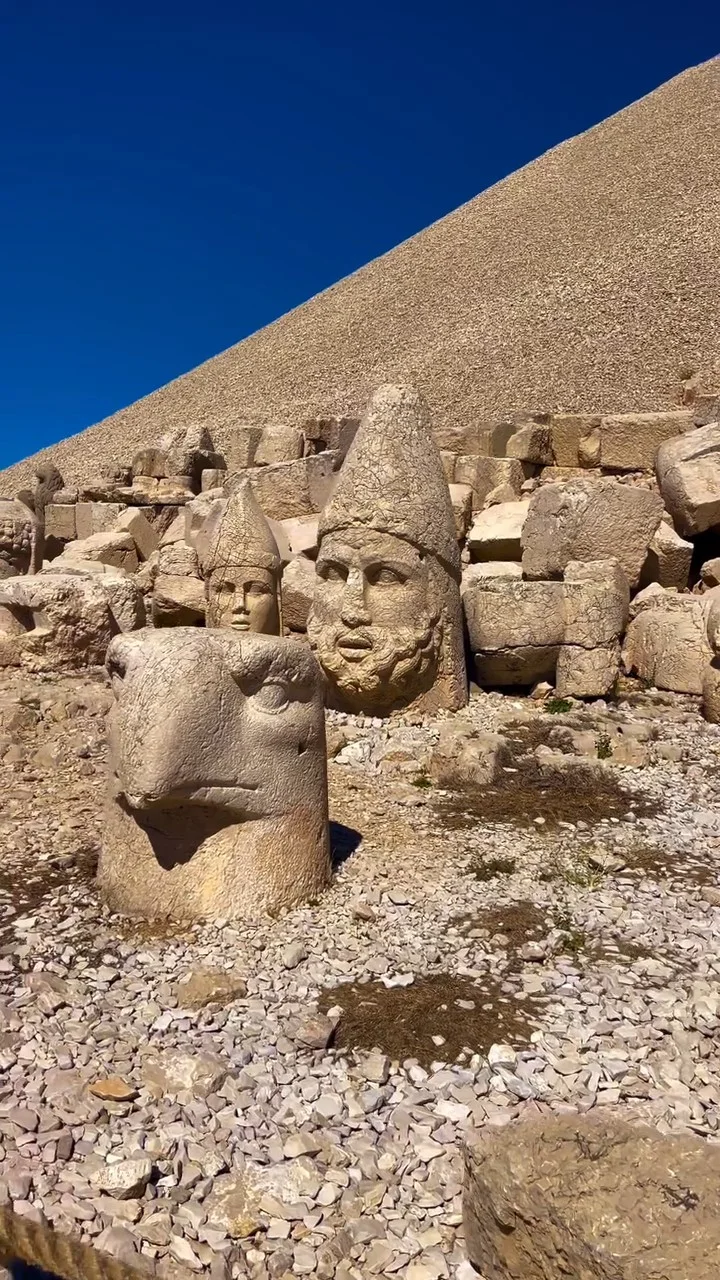
A nose emerges from the darkness. Then a beard, a broken crown, an enormous cheek catching the first trace of light. Behind the stone heads, seated bodies rise against a mound of loose rock.
The wind presses through your jacket. Your fingers stiffen around the camera. Under your shoes, gravel shifts with a dry crunch.
You have come to the summit to watch the sun rise. But as the light grows, another presence becomes harder to ignore: a king who had his own image placed beside the gods.
This is Mount Nemrut, in the Kahta district of Adıyaman, southeastern Türkiye. Its summit sanctuary was commissioned in the first century BC by Antiochos I, ruler of Commagene, as a monumental place of royal burial and worship. The complex entered the UNESCO World Heritage List in 1987.
To understand what you are looking at, start with the man who ordered it built.
A King with Two Ancestries
Antiochos ruled a kingdom whose identity drew on both Persian and Greek traditions.
At Nemrut, he presented his ancestry through two distinguished lines: Persian royalty on his father’s side and Macedonian royalty on his mother’s. UNESCO describes this partly legendary genealogy as an expression of a dynasty’s ambition to remain independent of powers to its east and west.
Here, ancestry became something visitors could see.
The monument brought royal forebears, divine figures and Antiochos himself into one carefully arranged setting. His place among them made a claim about who he was and where his authority belonged.
We cannot know exactly what he felt when he considered the mountain. His intentions survive more clearly than his emotions: he wanted a sanctuary, a funerary monument and an enduring royal cult.
The scale leaves little doubt about how seriously he took that ambition.
Read the Faces Before You Photograph Them
The east and west terraces contain monumental seated figures, with fallen heads now resting below the bodies. Lions and eagles stand as guardians at the ends of the sculptural groups.
The heads dominate most photographs of Nemrut. When you arrive, look beyond them.
Follow the line from a face on the ground to the seated figure behind it. Imagine the head in its original position. The statue becomes taller in your mind, and the arrangement begins to recover some of its intended force.
Among the figures are Antiochos, the goddess Commagene, Zeus-Oromasdes, Apollo-Mithras and Heracles-Artagnes. Their combined names reflect the sanctuary’s joining of Greek and Iranian religious traditions.
These names matter. They show that the meeting of cultures was built into the monument itself.
Move slowly along the permitted viewing areas. Notice a beard cut into limestone, the shape of a headdress, an eye whose outline remains visible despite the weathered surface. From a distance, the heads can seem alike. Close observation gives each one its own character.
Keep your hands off the sculptures. Let the changing light reveal the texture.
The Mountain Behind the Statues Was Made by People
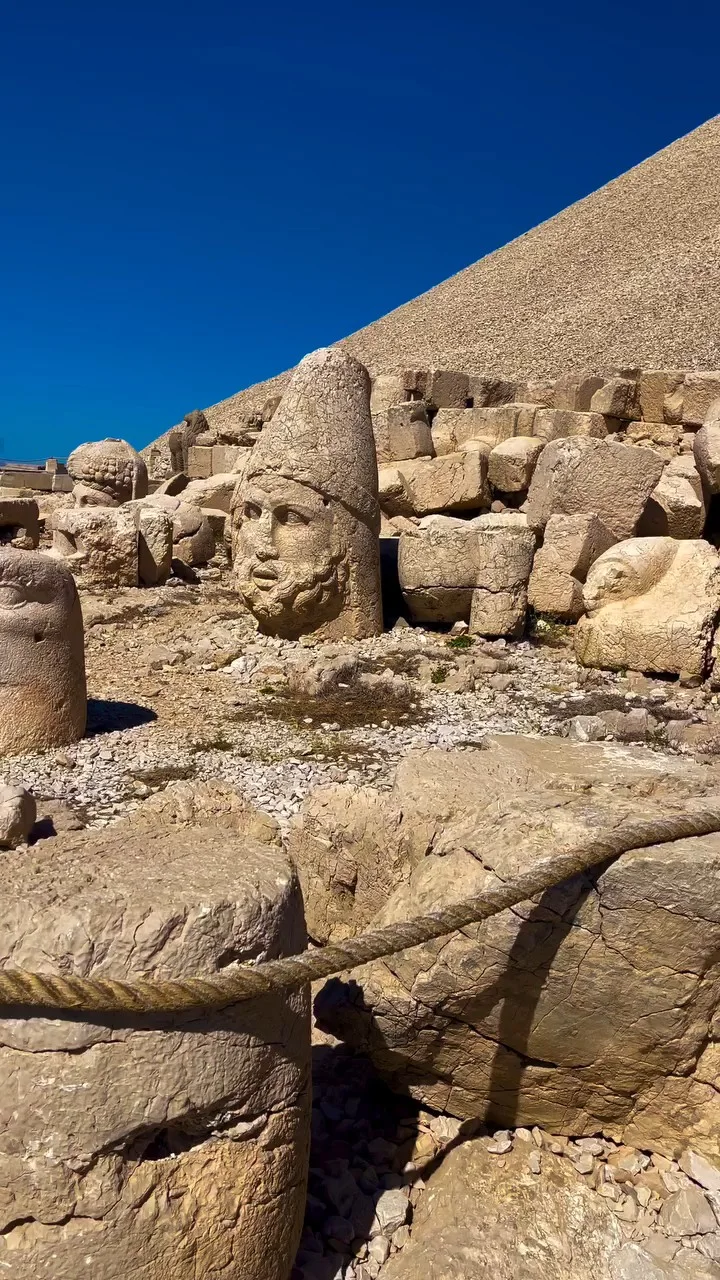
Behind the figures rises the tumulus, a funerary mound constructed from fragments of stone.
UNESCO describes it as approximately 50 metres high and 145 metres in diameter. Some blocks used in the wider monumental complex weigh up to nine tonnes.
Pause long enough to distinguish the mound from the mountain beneath it.
That great slope of broken stone was deliberately assembled. The terraces, sculptures and mound belong to an undertaking that required planning, skilled labour and the movement of heavy material to a high, exposed site.
Your own climb gives those facts a physical meaning.
You feel the incline in your calves. You stop to catch your breath. Then you look at a stone figure far larger than your body and consider the work required to put it there.
Nemrut becomes easier to understand when you allow the effort of reaching it to remain part of the visit.
A King Who Left Instructions
Antiochos also left words.
Behind the monumental figures is a long Greek inscription known as the Nomos, setting out religious and social provisions for his sanctuary. The Ministry of Culture and Tourism records it as a text of 237 lines.
The inscription helps explain the terraces as places intended for ceremony. People were meant to gather here, observe prescribed practices and sustain the king’s commemoration.
When you walk between the viewing areas, remember that you are moving through a designed sacred landscape. The arrangement had a purpose before it became a photographic destination.
Its intended visitors came with duties and beliefs. You arrive with questions.
Both encounters begin with looking up at the same stone figures.
What Happened to the Heads?
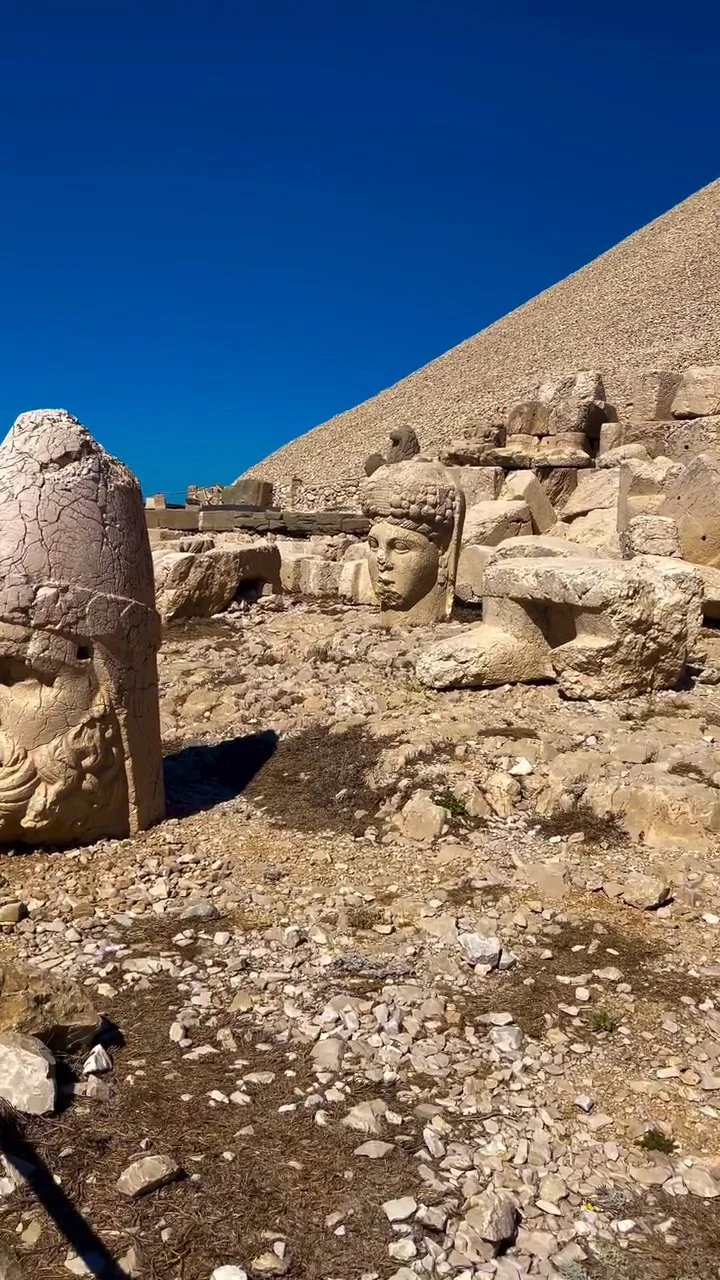
Their separation from the seated bodies gives Nemrut its unsettling appearance.
A face lies close enough to meet your gaze, while the body it belonged to remains above it. The distance between the two makes damage immediately visible.
UNESCO records the heads as fallen and identifies weathering, seasonal temperature changes, snow and other environmental pressures among the monument’s conservation concerns.
Avoid turning every broken surface into evidence of a dramatic attack. What can be seen today deserves careful description: displaced heads, damaged features and stone exposed to a severe mountain environment.
Look at the mouth of one figure. Then its eyes.
The expression can seem calm even where the face is fractured. That is part of what makes these sculptures so arresting: enough survives for you to recognise a face, while the damage keeps reminding you how much time has passed.
Sunrise or Sunset?
The east terrace is the natural choice for sunrise. The west terrace offers the corresponding sunset setting. Both contain sculptural groups, and the northern terrace connects the two sides of the complex.
Choose according to the journey you want to make.
Sunrise means travelling and walking before daylight. You may spend the first part of the visit cold, watching the horizon while the sculptures remain indistinct. As the sun reaches them, details appear gradually.
Sunset lets you approach in daylight and understand the terrain before the light begins to fade. Warm light can bring out the relief of the faces, but your return may take place in darkness.
Neither guarantees clear skies or an empty terrace.
Allow time to see both sides rather than leaving immediately after the sun crosses the horizon. The light changes quickly; the sculpture deserves longer.
For photographs, take a wide view that includes the seated bodies and mound as well as the heads. Then choose a detail. A face alone is striking, but the wider frame shows the monument Antiochos commissioned.
The Cold Is Part of the Journey
Nemrut’s archaeological terraces sit above 2,000 metres. Official descriptions give different precise elevations, but the practical point is consistent: this is a high mountain visit.
Dress for the summit rather than the temperature in town.
Bring a warm layer and a jacket that blocks the wind. For an early or late visit, gloves can make waiting much more comfortable. Wear shoes with grip, carry water and bring a torch or headlamp if you will walk in darkness.
The final approach involves walking uphill. Give yourself a pace at which you can watch your footing and still enjoy the arrival.
Before dawn, the sensory details are small and immediate: your own breathing, grit beneath your soles, cold air against your cheeks. There may be little scent on the exposed terrace. Later, a hot tea at your accommodation or a stop along the route can feel unusually good—the warmth against your palms, the slight bitterness of the first sip.
There is no need to make the mountain smell of incense or imagine a feast beside the statues. The place is powerful in its actual sparseness.
Plan the Visit Before Leaving Town
Arrange your transport in advance, especially for sunrise. Confirm the departure time, the approach being used and the return plan with your driver or guide.
Do not rely on a generic opening time for a dawn visit. The official museum listing states that access hours can vary with sunrise and sunset. Turkish Museums also advises checking with the museum directorate during December, January, February and March, when winter conditions affect whether the site is open.
Confirm admission arrangements and road conditions close to your visit. Weather can change the experience more than any itinerary suggests.
Allow roughly two hours for the summit walk and terraces, with extra time if you want to wait for the light. This is a planning allowance; travel from your accommodation is additional.
Visitors with limited mobility should ask specifically about the uphill approach, steps, surface and available assistance before booking. A vehicle reaching the visitor area does not mean it reaches the sculptures.
When the Light Finally Arrives
At sunrise, watch one face rather than the entire horizon.
Choose a cheek still in shadow. Wait until the light reaches its edge. The surface changes from grey to pale gold, and small marks you could barely see become distinct.
Around you, cameras rise. Someone speaks softly. The wind continues across the terrace.
Antiochos could prescribe ceremonies and commission enormous figures. He could have his name cut into stone. He could place his likeness among the gods.
More than two thousand years later, you stand before that likeness, trying to understand the person behind it.
Then the sun moves higher, and another part of the face comes into view.
Mount Nemrut Visitor Summary
| Detail | What to know |
|---|---|
| Place | Mount Nemrut Archaeological Site — Nemrut Dağı Ören Yeri |
| Location | Kahta district, Adıyaman, southeastern Türkiye |
| Historical period | First century BC, Kingdom of Commagene |
| Commissioned by | King Antiochos I |
| Purpose | Royal funerary monument and religious sanctuary |
| UNESCO status | World Heritage Site since 1987 |
| Main sights | East and west sculptural terraces, fallen stone heads, seated figures, guardian animals and tumulus |
| Elevation | Above 2,000 metres; precise figures differ between official descriptions |
| Sunrise viewing | East terrace |
| Sunset viewing | West terrace |
| Suggested duration | Around two hours for the summit approach and terraces; travel time is additional |
| Physical effort | 3/5 as a practical estimate; uphill walking, altitude and weather affect comfort |
| Bring | Warm layers, windproof jacket, suitable shoes, water and a light for walking in darkness |
| Winter access | Confirm opening and road conditions before travelling |
| Conservation | Stay on permitted routes; do not touch or climb the sculptures or tumulus |
Historical details follow UNESCO and official museum descriptions. Duration and effort ratings are practical estimates.
💬 Comments (0)
Traveler comments are shown in their original language.
No comments yet. Be the first to share your experience.
💬 Want to join the discussion?
Log in or create an account to leave a comment.