Cendere Bridge: The Missing Column and the Roman Emperor Who Wanted His Brother Forgotten
Three columns stand beside Adıyaman’s Cendere Bridge. The missing fourth reveals a Roman family tragedy, while the great stone arch carries visitors across a dramatic canyon landscape.
 Burak ÇınarTurkTravelRadar Founder
October 3, 2026
There should be four columns.
You can count only three.
At first, the missing one seems a small detail beside the great stone arch. The bridge rises over the water at the mouth of a rocky gorge, its pale masonry standing against the darker folds of the canyon. Your eyes follow the curve beneath the crossing, then return to the columns.
Two at one end. One at the other.
The fourth honoured Geta, a son of the Roman emperor Septimius Severus. According to the official account of the bridge, it was removed after his brother Caracalla had him killed and ordered the destruction of monuments bearing his name.
Once you know that, the empty space becomes difficult to overlook.
This is Cendere Köprüsü, also known as the Severan Bridge, in Adıyaman. People come for its Roman engineering and canyon setting. Among its surviving stones, they also encounter the consequences of a family’s struggle for power.
A Bridge Built Under Septimius Severus
Cendere belongs to the early third century AD. It was built under Emperor Septimius Severus, who ruled from AD 193 to 211, by the Sixteenth Legion, then based at ancient Samosata, near modern Samsat. It crosses the stream known in antiquity as Cabinas.
Stand back before crossing.
The bridge makes more sense when you see the landscape it had to negotiate. Rock closes around the watercourse. The builders placed the main arch between firm rock supports at a narrow section of the stream. The provincial tourism authority describes that arch as constructed from 92 large dressed stones, with a smaller secondary opening beside it.
The result has a remarkable economy of shape.
The main arch spans the gap in one broad curve. Above it, the roadway climbs towards the middle, then descends to the opposite bank.
From a distance, the form looks simple. Walk closer and consider the weight.
Each block had to be prepared, moved and placed. The crossing had to carry people and loads while the water continued beneath it. Your own few minutes on the bridge rest on the decisions of builders who worked here roughly eighteen centuries ago.
The Family at the Two Entrances
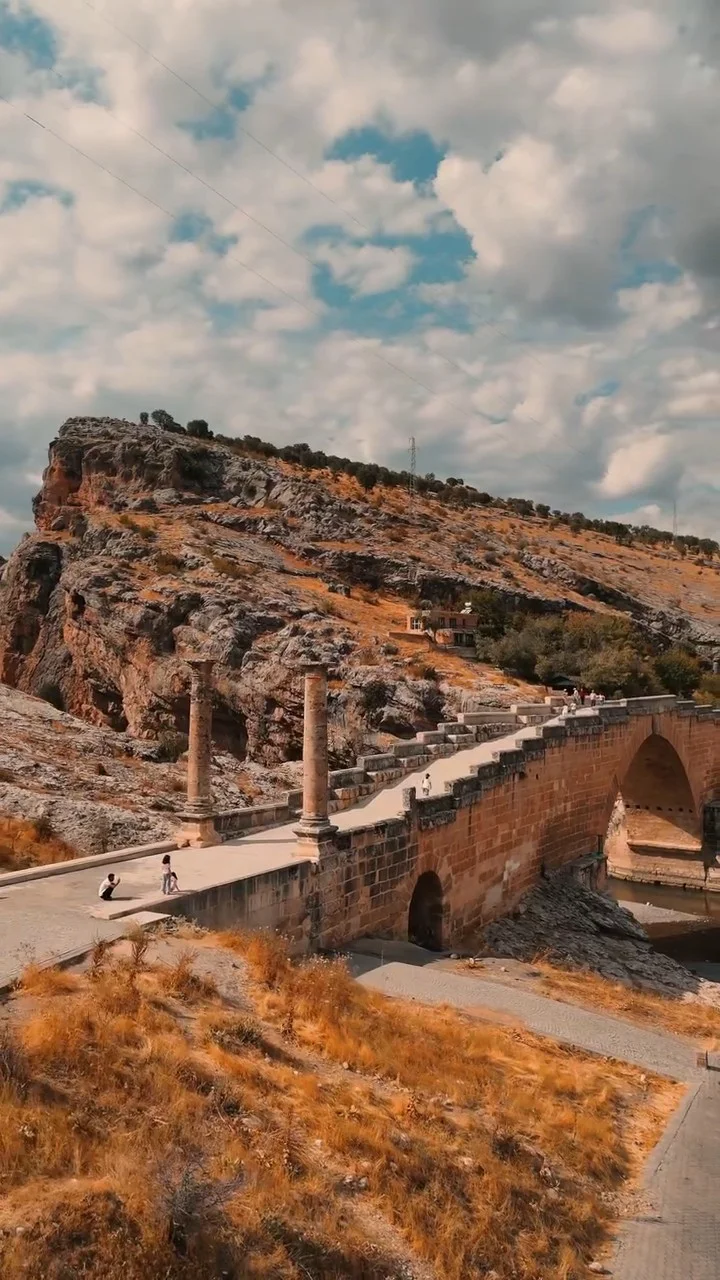
The columns made the crossing a monument to the imperial family.
The surviving inscriptions identify dedications to Septimius Severus, his wife Julia Domna, and their son Caracalla. The fourth column was dedicated to their other son, Geta.
Picture the original arrangement from the safe approach: a pair of columns at either end, marking your entrance and departure.
Anyone crossing passed through a display of dynastic authority. The family’s names stood beside a useful public work, joining the emperor’s household to the road through the landscape.
Then the family fractured.
After Septimius Severus’s death, Caracalla had Geta killed. The official bridge history connects the missing column to the subsequent destruction of Geta’s commemorations.
You do not need to invent an argument between the brothers or imagine their last words. The consequence is visible here.
A monument intended to honour four people now honours three.
What the Empty Space Preserves
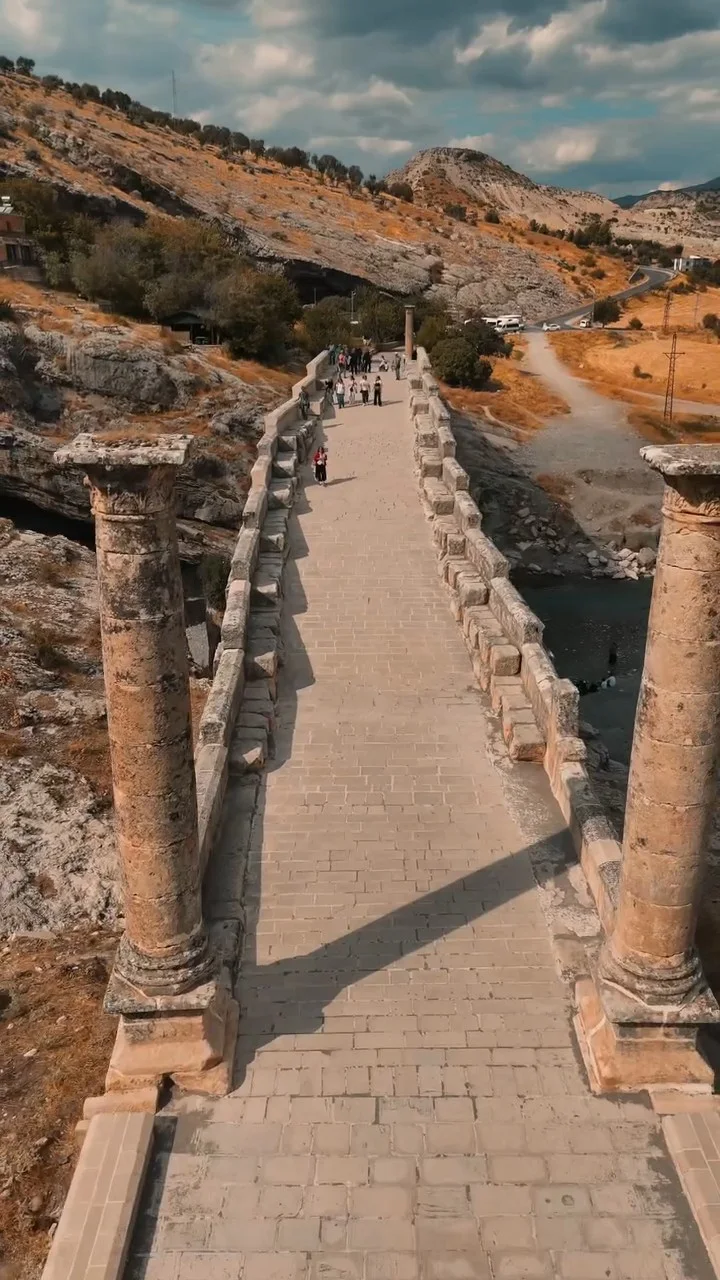
Look at the end with the lone column.
Without the history, you might assume its partner fell through age or neglect. Knowing the account changes what you see: the absence has a political meaning.
We cannot recover the scene of its removal. The surviving bridge does not tell us what the workers said, who watched or how long the task took.
What remains is the broken arrangement.
The attempt to remove Geta’s commemoration has become one of the reasons visitors learn his name. You arrive asking about the bridge, count the columns and leave remembering the person whose column is gone.
Cross Slowly Enough to Feel the Shape
Begin walking towards the middle.
The rise in the roadway is easier to understand beneath your feet than in a photograph. Your stride adjusts to the incline. On a hot day, the sun presses against your shoulders; in cooler weather, a breeze through the gorge may make you reach for another layer.
Listen as you go.
When the stream is flowing strongly, water may dominate the sound below. In drier conditions, you may notice your footsteps and the voices of other visitors more clearly. The water level and the character of the place change with the season.
Near the middle, pause where you can do so safely.
Look towards the rocky opening of the gorge. Then turn to the broader landscape on the other side. The crossing holds those two views together: enclosed rock in one direction, more open space in the other.
There may be little scent on the exposed roadway beyond dry dust. Near the water, depending on conditions, the air can carry the smell of damp ground.
Let those modest details remain modest. Cendere’s atmosphere comes from the place itself.
The Arch That Carries the Crossing
The Ministry of Culture and Tourism describes the bridge as approximately 120 metres long and 7 metres wide, with a main arch and a smaller relief arch. It also records its construction with carefully fitted stone blocks without mortar.
Look along the joints from an authorised viewing position.
In a masonry arch, the shaped stones carry load through compression towards the supports. At Cendere, that structural principle becomes something you can see in the curve.
The bridge’s survival also includes maintenance. The municipality’s account notes inscriptions recording repairs during the Roman period.
Its age deserves admiration, but so does the attention that helped it endure.
Where to Photograph Cendere Bridge
Take your first photograph from a safe viewpoint beside the crossing, far enough back to show the main arch and its rocky setting.
A picture taken only on the roadway misses much of the structure. From the side, you can see the curve supporting the path you have just walked.
Then photograph the columns.
Try to include enough of the approach to make their arrangement understandable. The missing fourth column is a story best told by showing what survives around the gap.
Early morning or late afternoon can bring gentler light to the masonry. Canyon walls may cast shadows across part of the scene, so look before choosing your position.
Stay on accessible public routes. Wet rocks, loose banks and steep edges can turn a search for a lower camera angle into an awkward climb. The bridge and canyon can be photographed without entering the stream.
Make It Part of an Adıyaman Journey
Cendere fits naturally into a route through Karakuş Tumulus, Arsameia and Mount Nemrut. The provincial tourism authority includes these places together in its regional sightseeing itinerary.
Their differences make the journey rewarding.
At Nemrut, you encounter the royal sanctuary of Antiochos I and the religious world of Commagene. At Cendere, you stand before a later Roman crossing carrying the names of the Severan family.
Give the bridge its own time rather than treating it as a photograph taken between larger stops.
Allow 30–45 minutes for a crossing, a look at the inscriptions and columns, and photographs from a safe viewpoint. That is a suggested visiting allowance; transport time is additional.
Arrange the wider route before setting out, particularly if it ends with sunset on Nemrut. Build in time for a meal. After walking in exposed places, warm bread in your hands and the first sip of tea can be as memorable as another hurried stop.
Carry drinking water and wear shoes with grip. Visitors with limited mobility should check the approach and walking surface before committing to the crossing.
Count Again Before You Leave
From the approach, look back at the columns.
Three slender shapes rise above the heavy body of the bridge. Beneath them, the arch continues to hold the crossing over the stream.
The builders solved a problem of distance and weight. The inscriptions announced a family’s power. The missing column records what happened within that family afterwards.
You can cross Cendere in a few minutes.
Understanding the empty space takes longer.
Cendere Bridge Visitor Summary
| Detail | What to know |
|---|---|
| Place | Cendere Köprüsü — Cendere Bridge |
| Other names | Severan Bridge; Septimius Severus Bridge |
| Location | Adıyaman province, on the Kahta–Nemrut sightseeing route |
| Historical period | Early third century AD, Roman Empire |
| Imperial association | Emperor Septimius Severus |
| Builders | The Sixteenth Legion, based at ancient Samosata |
| Structure | A large main arch and a smaller relief arch |
| Approximate dimensions | 120 metres long and 7 metres wide, according to the Culture Portal |
| Columns | Three survive from an original arrangement of four |
| Missing column | Dedicated to Geta; official accounts connect its removal to Caracalla’s suppression of his memory |
| Suggested duration | 30–45 minutes, excluding travel |
| Physical effort | 2/5 as a practical estimate; the roadway rises towards the centre |
| Photography | Include the arch and canyon, then photograph the column arrangement |
| Route pairing | Karakuş Tumulus, Arsameia and Mount Nemrut |
Historical details follow official cultural and municipal descriptions. Duration and effort ratings are practical estimates.
💬 Comments (0)
Traveler comments are shown in their original language.
No comments yet. Be the first to share your experience.
💬 Want to join the discussion?
Log in or create an account to leave a comment.