A Russian Prison in Beyoğlu, the place everyone passes by without knowing
Taste Kanlıca yogurt beside the Bosphorus, discover a mosque by Mimar Sinan and explore the neighbourhood’s lanes, with an optional climb to Mihrabat Grove.
 Burak ÇınarTurkTravelRadar Founder
September 30, 2026
As you walk along İstiklal Avenue towards Tünel, slow your pace. Look through the entrance of Narmanlı Han.
The avenue continues moving behind you. Footsteps, conversations and distant music blend together. Once you enter the courtyard, those sounds shift further away. The surrounding façades, doors and windows draw your attention away from the street.
You can stop here for a short break. But before sitting down, take a moment to look around.
This building carries a history stretching from Russian diplomatic use to the years when writers and painters lived and worked here. What makes Narmanlı Han compelling is the way the same rooms opened onto very different lives over time.
Beyoğlu’s Russian Past
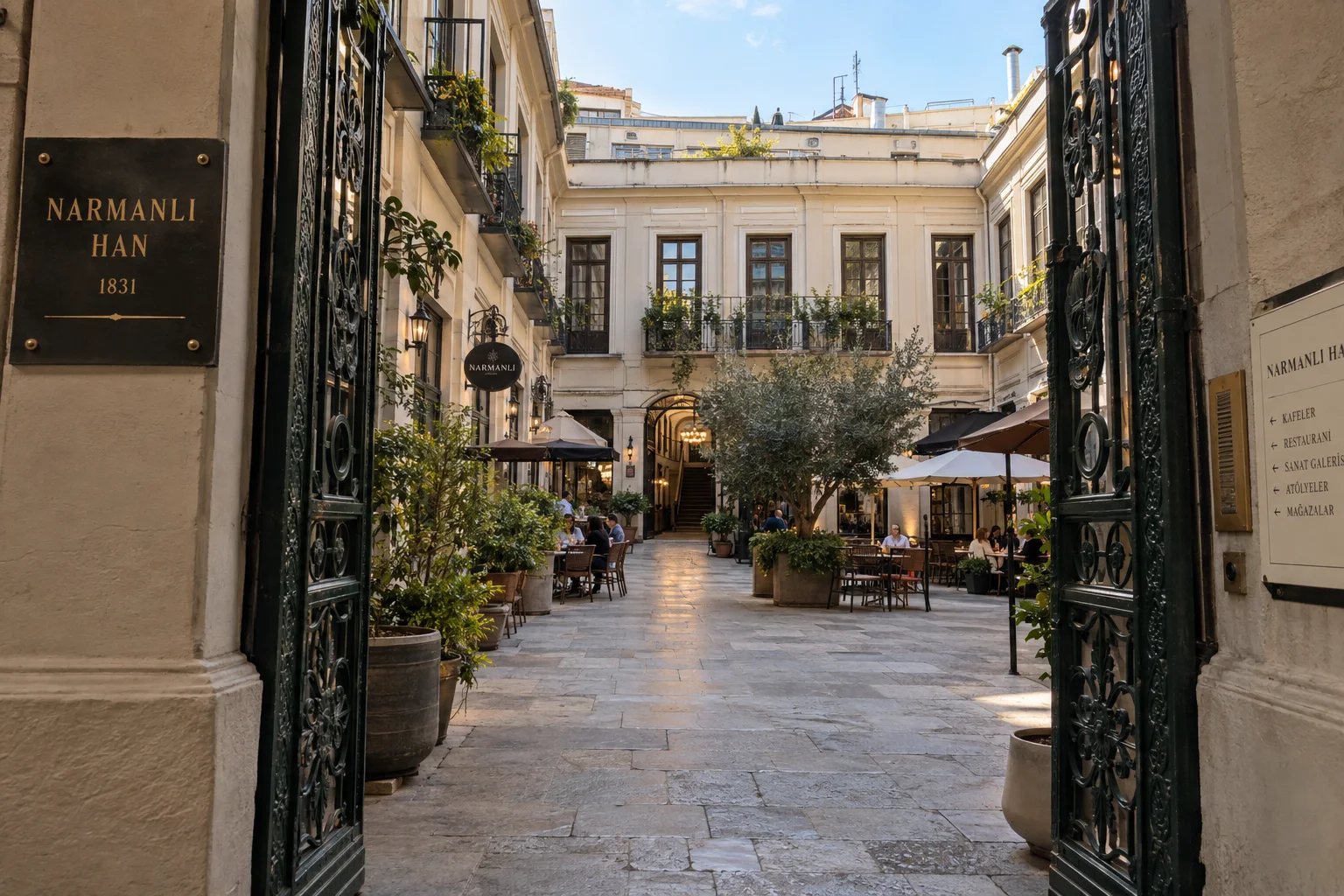
Narmanlı Han is generally dated to 1831. For many years, the building was associated with Russian embassy activities; consular offices continued to use it in a later period. Accounts of its history also describe its use as a prison.
Standing in the courtyard today, you may find that past difficult to picture. Imagine diplomats passing through one doorway, people held in another part of the building, and officials carrying documents between rooms. At different moments, the same structure served diplomatic, administrative and custodial purposes.
Sources differ on the precise dates of its embassy and prison functions. Rather than treating its history as a series of neatly separated chapters, it is more useful to understand it as a building connected to Russia’s presence in Istanbul, whose functions changed over time.
That connection also changes how you see Beyoğlu. The story of a single building can lead you beyond its courtyard, towards the Bosphorus and the relationships between states.
From a Courtyard to Diplomacy on the Bosphorus
To understand Narmanlı Han’s early years, it helps to take a brief look at the shifting politics of Sultan Mahmud II’s reign.
Relations between the Ottoman Empire and Russia involved more than warfare. When circumstances changed, recent adversaries could also enter into military cooperation.
As the forces of Mehmed Ali Pasha of Egypt advanced, the Ottoman government sought Russian assistance. In 1833, a Russian fleet entered the Bosphorus, and Russian troops landed at Beykoz, establishing a camp at Hünkâr İskelesi. On 8 July that year, the two states signed a defensive alliance intended to last eight years.
These events reveal Istanbul’s place at the centre of international politics. However, the Treaty of Hünkâr İskelesi, signed in 1833, should not be presented as the reason for constructing Narmanlı Han, which is dated to 1831. The building’s Russian connections and this diplomatic rapprochement belong to the same broad historical setting, but that does not establish a direct link between the treaty and the building’s foundation.
A brief historical note
The Ottoman Empire and Russia signed the Treaty of Hünkâr İskelesi on 8 July 1833. It was not renewed when its eight-year term ended. A new international arrangement governing the Straits followed in 1841.
Now return your attention to the courtyard. In the next chapter of Narmanlı Han’s history, diplomatic affairs give way to the people who rented rooms here to live and work.
The Narmanlı Brothers and a New Chapter
Avni and Sıtkı Narmanlı purchased the building in 1933. It subsequently became known by their name. Over time, carpet dealers, antique sellers, a notary and clothing businesses occupied spaces here, while artists also began renting rooms.
That mixture matters. Narmanlı’s artistic life developed within an ordinary working environment. People conducted business, made their homes, welcomed friends and produced their work.
The name “Narmanlı Yurdu” recalls this period. Although yurt can mean a student dormitory in modern Turkish, that meaning does not adequately describe the building’s life here. It brought together spaces where different people lived and worked.
Look at the doors around the courtyard with that in mind, and the building takes on a more personal scale. You begin to imagine rooms someone left each morning and returned to each evening, and others where a person worked for hours without noticing the time.
Tanpınar’s Small Apartment
One of the writers most closely associated with Narmanlı Han is Ahmet Hamdi Tanpınar.
In Tatyana Moran’s recollections of his move here, we encounter a modest ground-floor apartment: one large room, a kitchen and a bathroom. Newspapers initially covered the windows in place of curtains, and a few plates and glasses were bought. These small details show how simply a new home could begin.
There is a difference between knowing a writer through the covers of his books and learning about the everyday details of the room he occupied.
As you picture Tanpınar working here, remember the apartment at other hours, too. The same recollections describe evenings filled with friends, folk songs and shared company. Life at Narmanlı included friendship and domestic routines alongside literature.
As you explore the courtyard, allow yourself to look beyond the label of “a building where a famous writer stayed.” Thinking about how someone actually lived here creates a closer connection with the place.
The Narmanlı of Painters and Writers
Aliye Berger and Bedri Rahmi Eyüboğlu also hold an important place in the building’s cultural memory. For a period, Narmanlı was a place where they and other artists lived and worked.
It is easy to list those names and move on. Give them a little more time.
Imagine different kinds of work taking shape in rooms opening onto the same courtyard. Writing in one room, painting in another; visits, conversations and everyday tasks in between. The building’s cultural significance comes partly from the proximity of those lives.
We cannot treat today’s courtyard as an exact image of the past. Still, knowing who lived here gives the doors and windows a meaning beyond their architectural appearance.
What to Look for in the Courtyard
The surrounding businesses may be the first things you notice at Narmanlı Han. For a few minutes, lift your gaze above them.
Start with the relationship between the entrance and the courtyard. Notice how you have moved from the bustle of İstiklal into this enclosed space. Then follow the façades: where are the doors, how are the windows arranged, and how do the buildings frame the courtyard?
Rooms gathered around a shared open space offer a useful starting point for thinking about the layout of historic hans. However, Narmanlı is best understood through its own diplomatic and cultural history, rather than being described simply as a trading caravanserai.
For a photograph, try framing the courtyard from the entrance. This can capture the transition between the avenue outside and the space within. For a second image, include the courtyard and its surrounding façades together. In closer views, look for the rhythm of doors and windows.
Before focusing on a single attractive detail, consider how your photograph can explain the place.
A Courtyard Changed by Restoration
Narmanlı Han’s restoration prompted debate over the loss of greenery from the old courtyard and the building’s altered appearance. Critics questioned how much of its former atmosphere had been preserved.
In a historic building, the setting people remember can matter alongside the preservation of old materials. The shade of a tree, an occupied room or an object that remained in the same place for years may never appear in an official timeline, yet each can become part of a place’s memory.
As you visit Narmanlı today, consider that change as another chapter in its history. There are differences between the courtyard in front of you and the courtyard described in older accounts. Knowing this encourages a more attentive visit.
Stepping Back onto İstiklal
Before leaving, look around once more.
The doors you noticed when you arrived now belong to several stories: the building’s Russian diplomatic past, the Narmanlı brothers’ commercial life, Tanpınar’s small apartment, the working years of painters, and a courtyard transformed by restoration.
Then step back onto İstiklal Avenue.
As the crowd draws you into the walk again, Narmanlı Han’s entrance will fall behind you. This time, though, you will know how much history a single doorway on this avenue can hold.
📍 Where Is It? (Address and Transportation) Address: İstiklal Caddesi No: 180, Asmalımescit Mahallesi, Beyoğlu/İstanbul
Location: At the Tünel end of İstiklal Caddesi, very close to Tünel Square. Directly across from it is the Swedish Consulate, and next to it is the Ziraat Bankası art gallery.
Transportation:
Metro: Şişhane Metro Station is only 30 meters away, a 1-minute walk.
Nostalgic Tram: The nostalgic tram running between Taksim and Tünel passes along İstiklal Caddesi.
Tünel Funicular: Take the historic Tünel funicular from Karaköy and get off at Tünel Square; Narmanlı Han is right there.
Distances:
Galata Tower: 5–10 minutes on foot (downhill)
Taksim Square: approximately 1.3 km
Galata Bridge: approximately 800 meters
🕐 When Is It Open? (Visiting Hours and Entrance Fee) Courtyard: Free entry. No ticket, no one waiting at the door. You can enter from İstiklal Caddesi and wander around freely.
Cafes and shops inside: For example, Caffé Nero is open from 07:00 to 00:00, every day.
Narmanlı Han is a commercial space with an open courtyard; there are cafes, restaurants, and shops. There is no such thing as "it opens at this time and closes at that time." You can enter whenever you want.
Note: There is also an Illusion Museum inside the han. If you want to visit it, you need to buy a separate ticket.
⏱️ How Long Should You Stay? 20–30 minutes is enough: wander around the courtyard, look at the building's facades, take photos.
If you sit at one of the cafes in the courtyard and have a coffee, set aside 1 hour. As you also said in your article, this is a place that says "slow down"; it is not a place to rush through.
☕ What to Eat/Drink? (Cafe, Restaurant, Prices) There are several cafes and restaurants on the ground floor and in the courtyard of the han.
Caffé Nero (Narmanlı Han branch):
Location: Ground floor of the han, shop number 1
What they have: Italian coffees, accompanied by classical music
Average per person: ~80 TL (including non-alcoholic drinks, average for two people)
Hours: 07:00 – 00:00
Viyana Kahvesi (prices from the branch near Galata Tower, for reference):
Cappuccino: ~305 TL
Americano: ~245 TL
Pistachio cake: ~495 TL
Recommendation: The cafes in the courtyard have prices slightly above the Istanbul average. After all, you are inside a historic building. If you only have a coffee, it is not very expensive; if you add dessert, the bill increases seriously.
🗺️ What Is Nearby? (Places to Visit Around) Narmanlı Han is already at the most central point of İstiklal Caddesi. There is a lot within walking distance:
Tünel Square: Right next to it, the Swedish Consulate is here
Galata Tower: 5–10 minutes on foot, downhill
Asmalı Mescit: The back street of İstiklal, with bars and restaurants
Galata Mevlevihanesi: A historic place where whirling dervish ceremonies are held
Çiçek Pasajı and Avrupa Pasajı: Historic passages on İstiklal
St. Antoine Church: The famous Catholic church on İstiklal Caddesi
Galatasaray High School: The historic school in the middle of İstiklal
💬 Comments (0)
Traveler comments are shown in their original language.
No comments yet. Be the first to share your experience.
💬 Want to join the discussion?
Log in or create an account to leave a comment.