Kadıoğlu Mosaics: A Roman Story Beneath a Village Garden
Discovered beneath private land in Çaycuma, the Kadıoğlu mosaics reveal a Roman country house decorated with mythological scenes. Explore their story and the latest access information.
 Burak ÇınarTurkTravelRadar Founder
October 3, 2026
A woman holds grapes. A man threatens her with a blade.
The moment has been motionless for centuries, assembled from small pieces of stone beneath the soil of Kadıoğlu village, in Zonguldak’s Çaycuma district. The local governor’s office identifies it as the Ambrosia mosaic: a decorated floor carrying a scene of startling violence.
Its discovery began with something far more ordinary.
In 2008, a villager unexpectedly found Roman mosaics on private land. Excavations subsequently revealed the remains of a country house, understood as a villa rustica, with richly decorated floors. A garden had concealed rooms belonging to a much older home.
There is an essential detail to know before planning a journey: Kadıoğlu is not currently a confirmed, regularly accessible mosaic museum. Reports published in May and July 2026 describe the mosaics as still awaiting presentation to visitors, with the floors covered following excavation. Arrange your plans around confirmed access rather than photographs of the exposed mosaics.
The discovery deserves attention even while its future as a visitor attraction remains unresolved.
The House Beneath the Ground
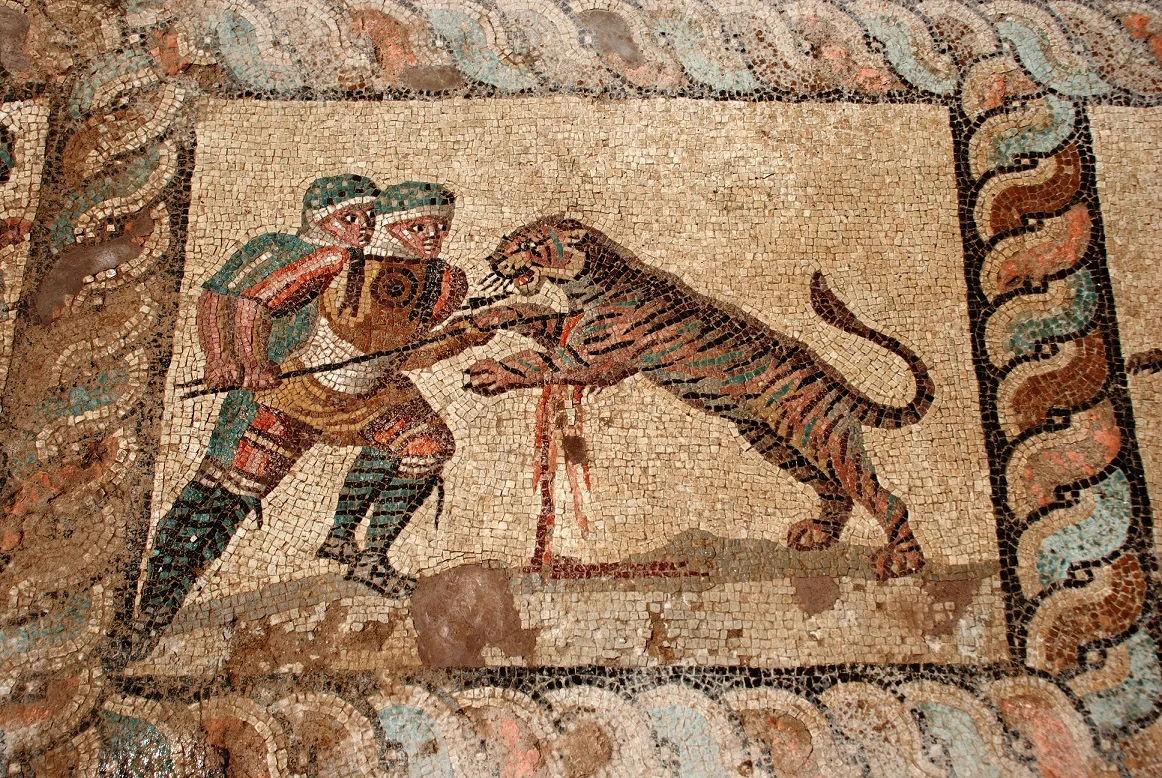
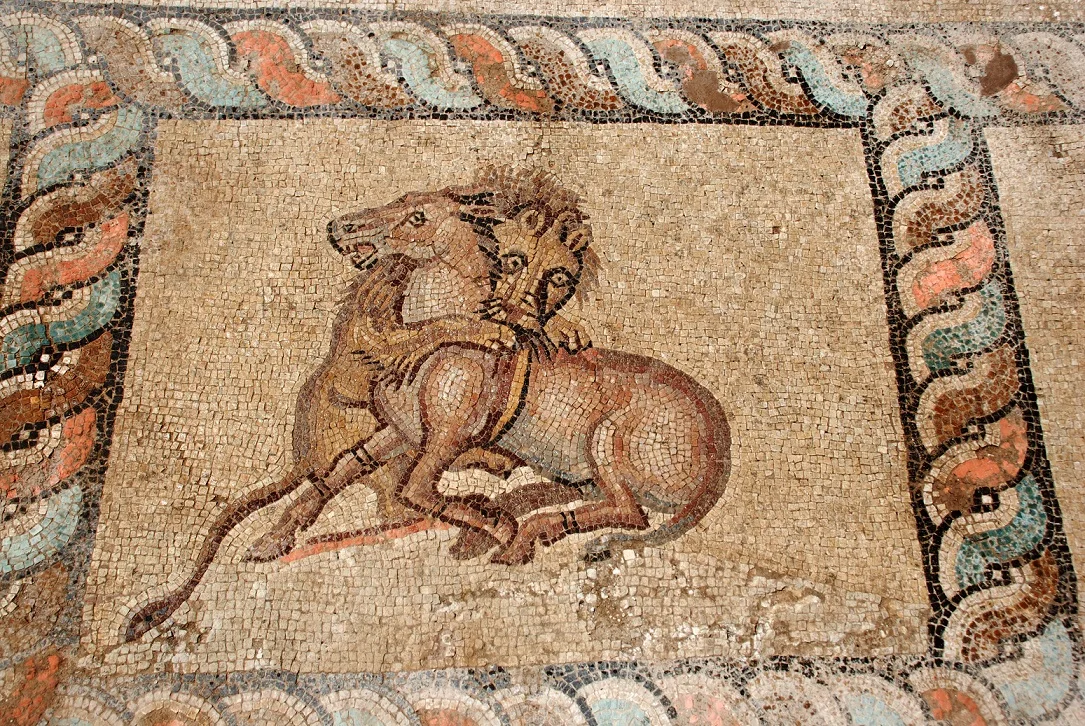
Archaeological research records three mosaic panels uncovered during rescue excavations between 2008 and 2010. Their subjects include hunting, animals in combat, masks, Eros and Psyche figures, geometric designs, and the mythological pairing of Lycurgus and Ambrosia.
The remains are generally associated with a third-century AD Roman country house.
“Country house” sounds modest until you consider the work beneath its occupants’ feet.
Someone planned these compositions. Craftspeople selected and positioned the pieces, making outlines, borders and figures readable across a room. A visitor entering the house would have encountered decoration as part of the architecture: an image spread across the floor rather than hung on a wall.
That changes how you read the discovery. These were living spaces. The mosaics belonged to rooms where people moved, received company and carried on with their days.
The owners’ identities remain uncertain. Attractive stories about a particular ruler or commander should not be mistaken for an established name attached to the house.
A Violent Scene in a Domestic Room
The Lycurgus and Ambrosia composition is the discovery’s most memorable image. The municipality identifies the male figure on the left as Lycurgus and the female figure on the right as Ambrosia; the governor’s office describes the grapes and threatening blade.
This is mythological imagery, not evidence of a real attack in the villa.
Even without knowing every part of the ancient story, the composition conveys tension. Grapes suggest something cultivated, gathered and held. The weapon introduces danger into that gesture.
Imagine encountering such a scene while entering someone’s home. The floor would give guests something to recognise and discuss. Its subject could demonstrate the owner’s cultural interests as well as the maker’s skill.
The surviving image allows that possibility. It does not preserve the conversations that took place above it.
Small Stones, Considerable Patience
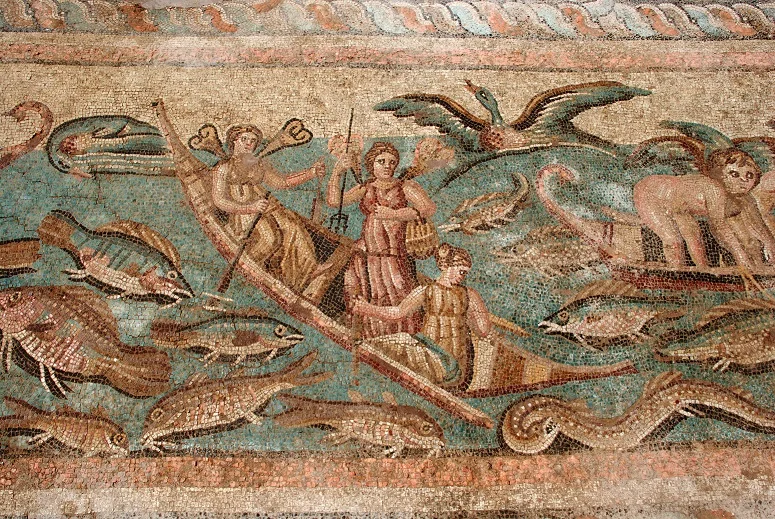
The photographs and archaeological descriptions reward a closer look at the borders as well as the central figures.
Geometric patterns organise the surface. Figural decoration introduces movement and expression. The masks have attracted their own scholarly study, showing that the surrounding imagery merits examination alongside the principal scene.
From a distance, a mosaic reads as a picture. Closer inspection reveals the decisions that make it work: a turn in the outline, a change of colour, the arrangement of individual pieces.
The texture may invite you to imagine how the floor would feel underfoot, cool and firm inside a room. That remains an imagined encounter with the ancient house. The surviving mosaics require protection, and visitors should never walk on or touch them.
The Coin Beside the Picture
The excavations also recovered pottery fragments, building remains and a coin issued under Emperor Valerian, whose reign lasted from AD 253 to 260.
A coin offers a different kind of evidence from a decorated floor.
The mosaic reveals artistic choices. The coin carries information about its period of manufacture. Archaeologists consider such finds together with the building and other material; one object alone does not establish the exact year every part of the house was built.
That combination makes Kadıoğlu more than an isolated artwork. It is an archaeological setting in which decoration, architecture and smaller finds contribute to understanding the same place.
Can You Visit Kadıoğlu Mosaics?
Confirm access before travelling specifically to see the mosaics.
A protective roof and visitor centre have been proposed to shelter the remains and allow people to understand them on site. The regional tourism project description presents these as planned facilities, rather than evidence of an operating museum.
The 2026 reporting indicates that public presentation remains unresolved. There are no opening hours or admission prices verified here that would justify promising a normal museum visit.
For enquiries, the Zonguldak Provincial Directorate of Culture and Tourism lists +90 372 280 19 00. Ask specifically whether the Kadıoğlu floors are exposed and whether authorised visitor access is available.
If access is arranged, follow the staff’s instructions. A covered excavation area cannot offer the same experience as the photographs taken while its floors were visible.
A Story to Carry Through Çaycuma
Kadıoğlu adds an intimate chapter to the region’s ancient history.
At a coastal city, you can think about harbours and journeys. Here, the scale contracts to a room: its floor, its decoration, the household that commissioned it.
You need not invent the scent of Roman wine or the sound of an ancient dinner to feel that closeness. The evidence is already compelling. A home stood here. Its occupants chose elaborate images for the surfaces around them. Those images survived long enough to be found beneath another generation’s garden.
For now, let the sensory pleasures belong to the wider Çaycuma journey: cool air after rain, the smell of wet earth, the sound of present-day village life. Later, over a warm glass of tea and its slightly bitter first sip, the discovery is something worth discussing.
Under an ordinary piece of ground, people had left a picture that outlasted their house.
Kadıoğlu Mosaics Visitor Summary
| Detail | Practical information |
|---|---|
| Place | Kadıoğlu Mosaics |
| Location | Kadıoğlu village, Çaycuma district, Zonguldak |
| Historical setting | Roman country house, generally dated to the third century AD |
| Discovery | First found in 2008; excavations followed |
| Notable subjects | Lycurgus and Ambrosia, hunting scenes, masks and geometric patterns |
| Visitor status | Regular public access is not confirmed; 2026 reports describe presentation as pending |
| Opening hours | Not verified |
| Admission | Not verified |
| Before travelling | Confirm that authorised access is available and the mosaics can be seen |
| Enquiries | Zonguldak Culture and Tourism Directorate: +90 372 280 19 00 |
Historical details follow archaeological research and municipal information; the access note reflects 2026 reporting.
💬 Comments (0)
Traveler comments are shown in their original language.
No comments yet. Be the first to share your experience.
💬 Want to join the discussion?
Log in or create an account to leave a comment.