Divriği Great Mosque and Hospital: Turkey’s UNESCO Masterpiece Carved in Stone
Discover Divriği Great Mosque and Hospital, a UNESCO World Heritage Site in Sivas famed for extraordinary stone carving. Explore its medieval portals, vaulted interiors and healing heritage, with practical visiting tips and local food.
 Burak ÇınarTurkTravelRadar Founder
October 1, 2026
At first, you see a stone building on the hillside.
Then you move closer to the entrance, and the details begin to take over.
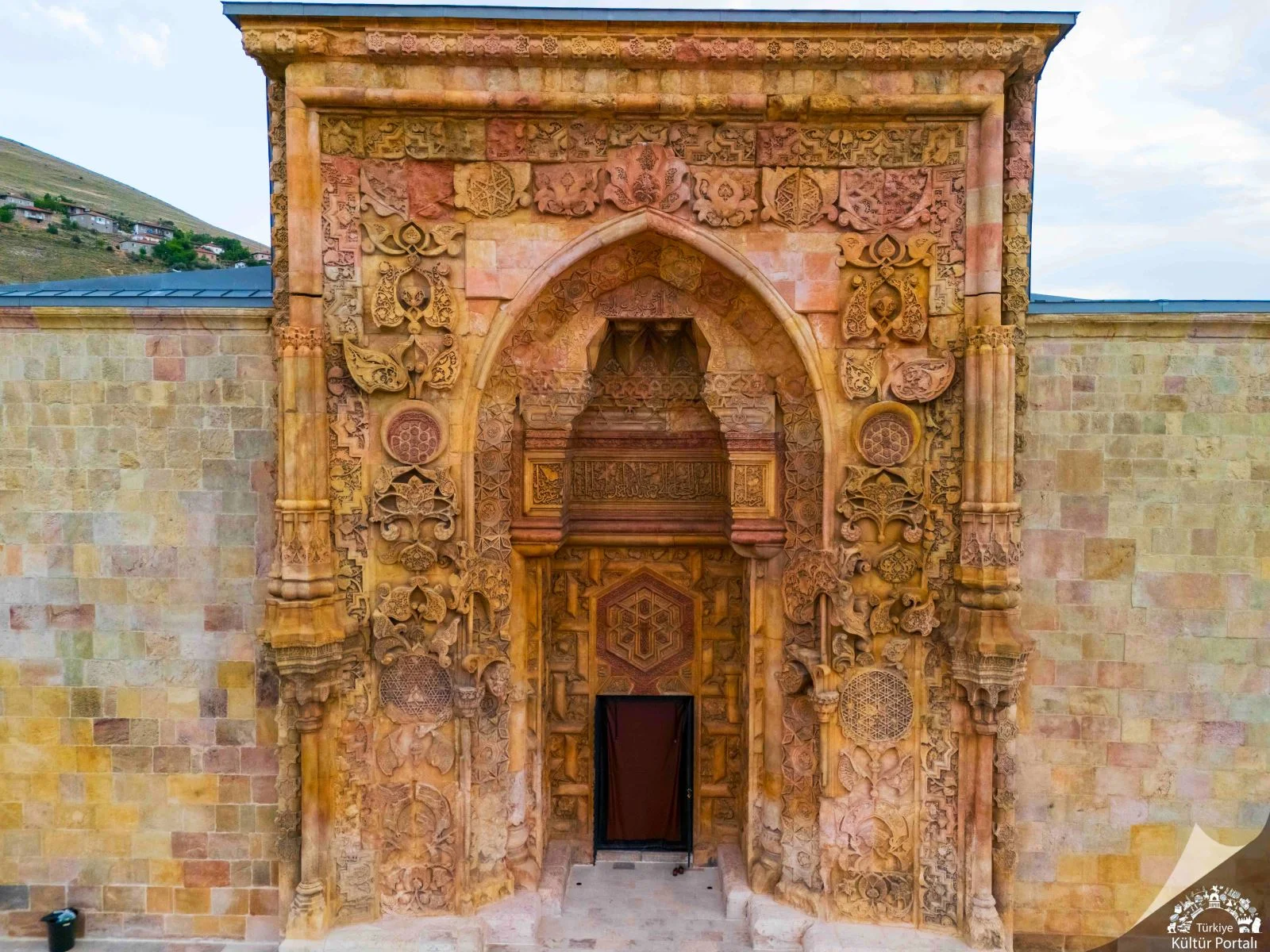
Leaves curl out of the stone. Geometric patterns fold into one another. Deeply carved forms catch the sunlight, leaving little pockets of shadow between them. Your eyes follow one shape, then another, and suddenly you are standing still.
**Divriği Ulu Camii ve Darüşşifası—the Great Mosque and Hospital of Divriği—**rewards that kind of attention.
Here in Sivas province, a medieval mosque and a place built for healing stand side by side. Come with enough time to explore both. The doorways may draw you here, but the spaces beyond them give the visit its depth.
Where Is Divriği Great Mosque and Hospital?
The complex is in Divriği, a town in Sivas province, below the slopes of its historic castle.
It is important to plan for Divriği itself rather than Sivas city centre. This is a separate destination, and transport should be part of your itinerary.
Save the Turkish name “Divriği Ulu Camii ve Darüşşifası” when looking for directions or asking locally. If you are travelling from Sivas, check current transport options and your return journey before setting out.
Once in town, allow for an uphill approach to the monument. Comfortable shoes will make it easier to enjoy the surroundings as well as the building.
Who Built the Mosque and Hospital?
The complex dates to 1228–1229, during the rule of the Mengücek dynasty.
Ahmed Shah commissioned the mosque, while Turan Melek commissioned the adjoining hospital. The architect is known as Hürrem Shah of Ahlat.
Those two purposes—worship and healing—are worth keeping in mind as you explore. The hospital is an essential part of the visit, with its own entrance and architectural character.
Imagine the effort behind these spaces: stone selected and shaped, structural problems solved, decoration carved with extraordinary care. Looking closely makes that labour feel more tangible than a date on a sign.
Why Is Divriği a UNESCO World Heritage Site?
The Great Mosque and Hospital of Divriği entered the UNESCO World Heritage List in 1985.
Its importance rests on both its architecture and its exceptional stone carving. The elaborate portals are the most immediately striking features, but the vaulted interiors deserve just as much attention.
For a visitor, the appeal is easy to feel.
Stand in front of a doorway and look at how far the carving projects from the surface. Shift your position slightly. Details that were hidden in shadow become clearer, while others disappear into the depth of the stone.
Bring your camera, certainly. But give your eyes a few uninterrupted minutes first.
What Should You Look For on the Carved Portals?
Start with the monumental entrances.
The mosque’s north portal, often called the Paradise Gate, has rich plant-like forms and sculptural decoration. The west portal, commonly known as the Textile Gate, invites comparison with woven patterns.
The hospital has its own richly carved portal, too.
Rather than trying to absorb everything at once, choose one small area. Follow the outline of a leaf or a geometric form. Notice where the carving is shallow and where it cuts deeply into the stone.
Then step back and see how that detail belongs to the whole entrance.
For photographs, take both a wider frame and a close view. The wider image shows the portal’s scale; the closer one reveals the craftsmanship. Side lighting can help bring out the relief, although the best conditions will depend on the weather and time of day.
Enjoy the textures with your eyes and keep your hands away from the historic carvings.
What Is It Like Inside Divriği Great Mosque?
Inside the mosque, your attention moves from the entrances to the space overhead.
Rows of substantial piers divide the prayer hall, supporting a varied arrangement of stone vaults. Look up slowly: the ceiling deserves more than a passing glance.
The mihrab, indicating the direction of Mecca, and the historic wooden minbar, the pulpit used for sermons, are further details to seek out.
If you enter after walking uphill, the pause itself can feel welcome. Your footsteps soften, conversations lower, and you have time to notice how light reaches different parts of the room.
Remember that the mosque is used for worship. Follow staff guidance, remove your shoes where required and give people praying the space they need.
What Was the Darüşşifa Used For?
Darüşşifa means a place of healing. This adjoining building served as a hospital.
Its interior is arranged around a lofty central space with a pool, with rooms opening around it. Look at the relationship between the central area, the surrounding chambers and the light from above.
It offers a different way to think about medieval architecture. Alongside structural skill and decoration, there was the practical task of creating a place where people could receive care.
The hospital’s acoustics and its association with water and music are frequently highlighted in local interpretation. If a guide discusses these traditions, ask how they relate to the building and its history. A performance or flowing water should not be assumed to be part of every visit.
Even in silence, the space gives you plenty to consider.
Is Divriği Great Mosque Open After Restoration?
The complex reopened for visits and worship in May 2024, following a major restoration lasting nine years.
That reopening makes older descriptions of a prolonged closure outdated. However, individual areas and visitor arrangements can still change, so check locally before a long journey.
An official educational visitor listing gives daily hours of 08:00–17:00. Treat these as published guidance and confirm your intended visiting time, particularly around prayers and holidays.
Current admission prices have not been independently confirmed here. Ask about the arrangements for the mosque and hospital rather than assuming both are covered by the same entry conditions.
What Should You Eat in Divriği?
After exploring the complex, ask whether a local restaurant is serving Divriği pilavı.
This regional rice dish can include meat, chickpeas, raisins, butter and aromatic spices. Recipes vary, so ask what is in the version being served.
A warm spoonful brings together savoury richness and little moments of sweetness. Chickpeas add a firmer bite, while spices such as allspice or clove give the rice a fragrant depth.
It is a lovely dish to seek out after a morning spent looking closely at stonework. Check availability and the price before ordering; it may not be prepared every day.
How Much Time Do You Need at Divriği?
Allow around 1–2 hours for the mosque, hospital and exterior details. This is a suggested planning allowance, particularly if you enjoy architecture or photography.
A local guide can help you understand features you might otherwise overlook. Ask about availability, language and the fee before agreeing to a tour.
Try to leave some time for simply looking. You may discover that one doorway holds your attention much longer than expected.
Before leaving, find a small detail you have not photographed yet. Look at the edge of a carved leaf, a recessed pattern or the meeting of two stone surfaces. It brings this remarkable building back to the scale of a craftsperson’s hands.
Quick Visitor Guide: Divriği Great Mosque and Hospital
| Visitor Information | Details |
|---|---|
| Turkish Name | Divriği Ulu Camii ve Darüşşifası |
| Location | Divriği, Sivas province, Turkey; below the historic castle |
| Construction Date | 1228–1229 |
| Patrons | Ahmed Shah for the mosque; Turan Melek for the hospital |
| Architect | Hürrem Shah of Ahlat |
| UNESCO Status | World Heritage Site since 1985 |
| Main Highlights | Carved portals, stone vaults, mosque interior and medieval hospital |
| Restoration Status | Reopened in May 2024 after a major restoration |
| Published Visiting Hours | Daily, 08:00–17:00, according to an official educational listing; confirm locally |
| Admission | Current prices and entry arrangements have not been confirmed |
| Suggested Visit Length | Approximately 1–2 hours |
| Getting There | Plan transport to Divriği separately from Sivas city; confirm current services and return options |
| Visitor Rules | Modest clothing; follow shoe-removal instructions and respect prayer times |
| Accessibility | Uphill approaches and historic thresholds may present difficulties; confirm step-free arrangements |
| Local Food to Seek Out | Divriği pilavı; availability varies |
| Walking Effort | 2/5 within the visit, potentially 3/5 with an uphill walk from town; depends on your route |
Practical Tips for Your Visit
- Check your return transport before travelling, especially if visiting from Sivas.
- Explore the hospital as well as the mosque to understand the complete complex.
- Photograph each portal from a distance and close up to capture both scale and detail.
- Keep hands and bags clear of the carved surfaces.
- Ask about guide language and fees in advance.
- Bring a headscarf for entering mosque prayer spaces, along with comfortable shoes.
- Confirm access before travelling if you need a step-free route.
💬 Comments (0)
Traveler comments are shown in their original language.
No comments yet. Be the first to share your experience.
💬 Want to join the discussion?
Log in or create an account to leave a comment.