Basilica Therma, Sarıkaya: Turkey’s Ancient Roman Bath and the Legend of a King’s Daughter
Discover Basilica Therma in Sarıkaya, Yozgat: an ancient Roman thermal bath where monumental arches, a natural hot spring and the legend of a king’s daughter meet.
 Burak ÇınarTurkTravelRadar Founder
October 1, 2026
Imagine arriving on a cold Anatolian morning.
The air brushes your face, sharp and dry. Before you, pale stone arches rise above a pool, their reflections trembling whenever the water moves. In the chill, warmth rising from the thermal spring may reveal itself as a delicate veil of steam.
Beyond the ruins, Sarıkaya carries on with its ordinary day. Footsteps pass, a vehicle moves through the town, voices drift across the street.
Yet here, beneath the surface, something much older continues.
This is Basilica Therma, the Roman thermal bath in Sarıkaya, Yozgat, in Central Turkey. Built around the second century AD, it brings together ancient architecture, a natural hot spring and a local story about a young woman whose recovery inspired a king to build a bath.
You may know it by another name: Kral Kızı Hamamı, the Bath of the King’s Daughter.
To understand why this place matters, begin with the water.
A Roman Bath Built Around a Natural Spring
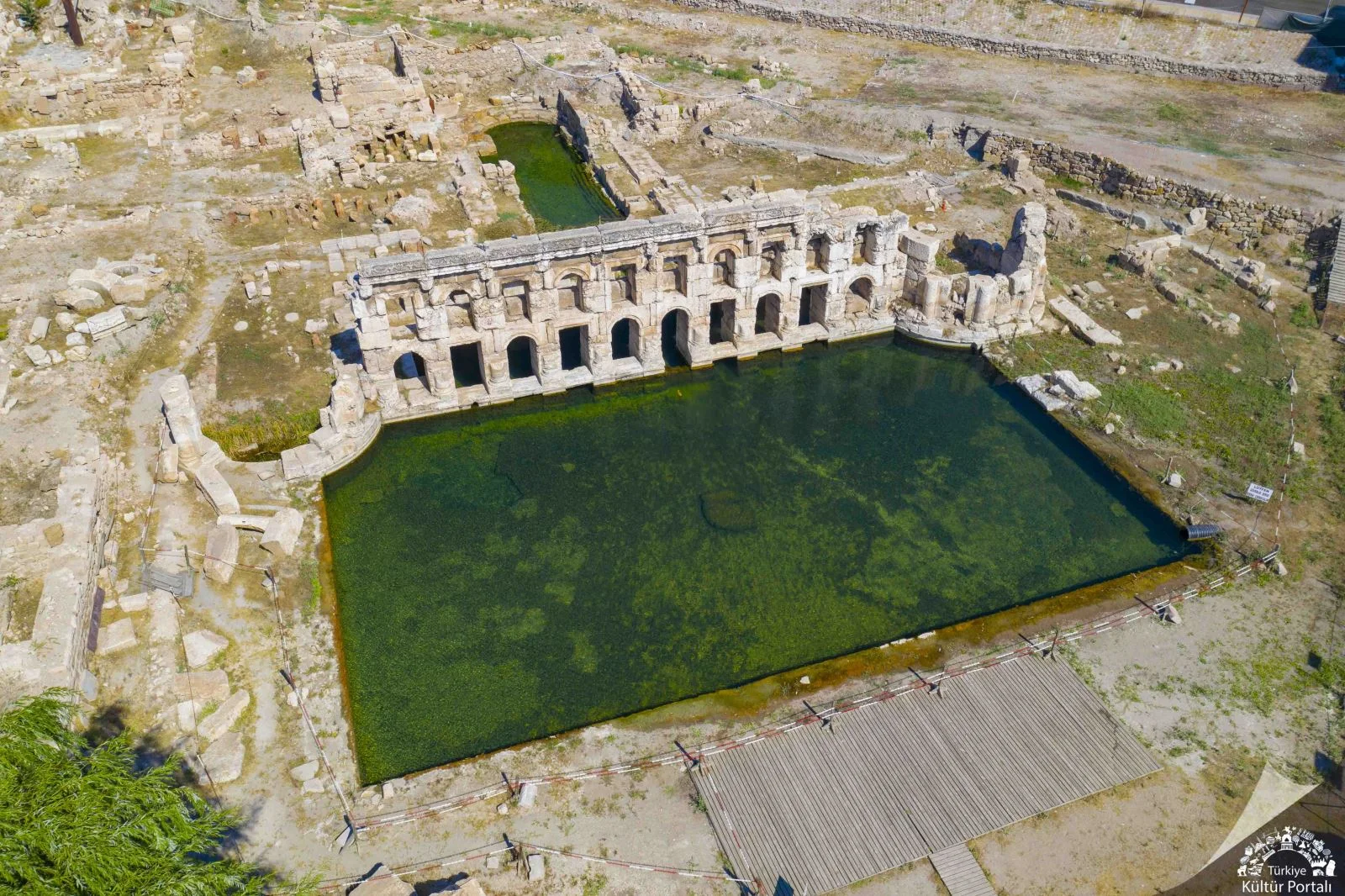
The Romans recognised the possibilities of Sarıkaya’s thermal source and constructed a substantial bath complex around it.
Here, naturally hot water emerged from underground and was used directly within the bathing structure. The spring determined the location; architecture gave it scale and ceremony.
Official Turkish heritage accounts date the surviving complex to the second century AD. They identify the Roman settlement with the name Aquae Sarvenae and associate the later Byzantine period with Basilica Therma.
Today, the surviving arched façade and excavated pools help you imagine the importance of bathing in the ancient town.
Look at the relationship between stone and water. The repeated arches establish a rhythm. The pool spreads before them, catching light and holding fragments of their reflection. Beneath the monumental appearance lies a practical achievement: building around an active thermal source.
For ancient visitors, this was a place to wash, meet and seek relief in warm water. For travellers today, it offers a vivid encounter with the way Romans shaped everyday life.
The Legend of the King’s Daughter
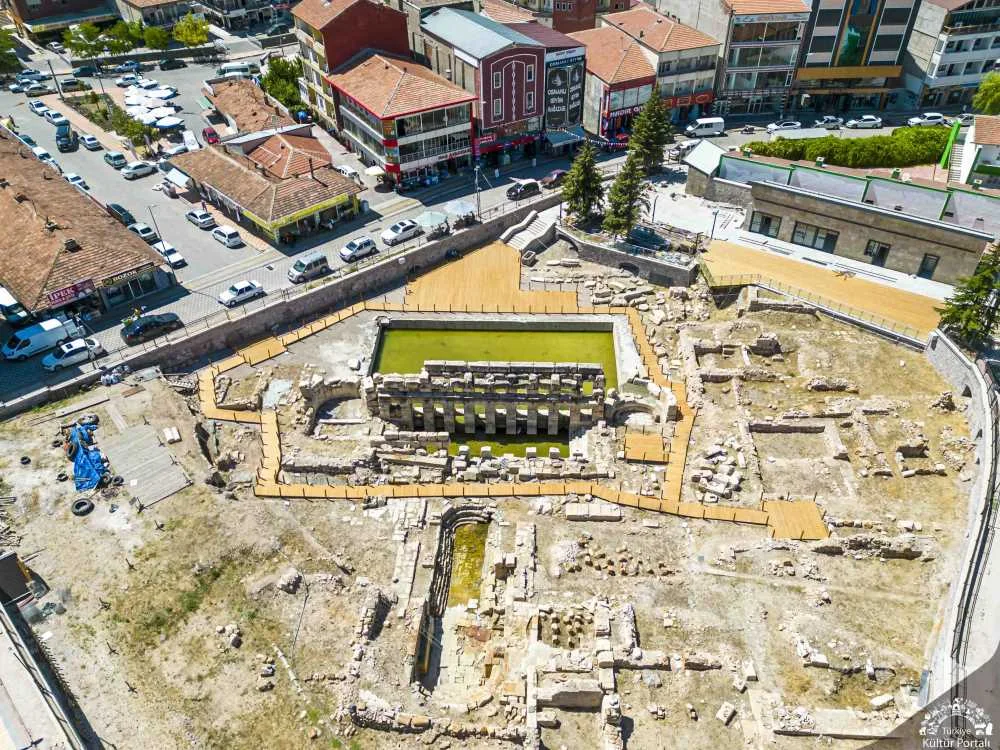
Local tradition gives the bath a more intimate beginning.
According to the story recorded by Turkey’s Culture Portal, a Roman ruler living in Kayseri had a daughter who became seriously ill. Her condition worsened until she could no longer walk. Her father sought help from physicians, but none could restore her health.
Eventually, she was sent to the warm springs at what is now Sarıkaya.
In the legend, the area was marshy, with a muddy pool formed by the hot water. The young woman spent time beside it and entered the warm water and mud with her companions.
Gradually, she began to improve. Movement returned, and she walked again.
Her grateful father ordered a marble pool to be built around the spring. A settlement grew nearby, and the place became associated with his daughter.
This is a local legend, rather than a documented account of the bath’s construction. It explains the affectionate name Kral Kızı Hamamı and reveals how deeply the spring belongs to Sarıkaya’s cultural memory.
Read the story before looking at the pools. The grand architecture suddenly gains a human scale: a worried father, a daughter and the hope placed in warm water.
From Roman Bathing to Byzantine Worship
The site’s story continued after the Roman period.
Official heritage descriptions connect its Byzantine identity with a church added to the north of the bathing complex. Water, already central to the settlement, acquired another role in its religious life.
A marble stone bearing a cross, found in the large pool, is interpreted in official accounts as a Byzantine baptismal stone.
It is a small detail with a considerable effect on how you understand the site. The same complex carried different meanings as the community around it changed.
Bathing and religious practice left their traces in one place. Later generations inherited both the structure and the spring.
The Water Outlasted the Empires
Sarıkaya’s thermal tradition continued through subsequent periods, including Seljuk and Ottoman rule.
The names changed. The buildings changed. People continued to value the warm water.
One particularly revealing detail appears in a 1905 Ottoman document cited by Sarıkaya’s district authorities: revenue from the baths was allocated to help pay teachers’ salaries in Boğazlıyan.
The spring therefore contributed to more than bathing. It also formed part of the region’s economic and social life.
That connection makes the site easier to understand. This was a resource used by a community over generations, with an influence reaching beyond the edges of its pools.
How the Pools Returned to View
The monument visible today also tells a story of archaeological recovery.
Parts of the complex had become buried or obscured, while modern development complicated the work of investigating an ancient bath in the middle of a living town.
Excavations beginning in 2010 revealed the large pool in front of the façade, followed by further pools behind it.
The discovery changed the way the surviving arches could be read. What might once have appeared as an isolated ancient wall became recognisable as part of a much larger bathing complex.
When you look at photographs of Basilica Therma, notice both the exposed architecture and the surrounding town. Their proximity is part of the story: archaeology here involves recovering the past within a place that people still call home.
Is Basilica Therma a UNESCO World Heritage Site?
Basilica Therma was added to Turkey’s UNESCO World Heritage Tentative List on 2 May 2018.
A Tentative List identifies places a country may put forward for future World Heritage nomination. It is a different status from inscription on the World Heritage List.
The submission highlights the bath’s architecture, thermal source and long history. It also compares the complex with the Roman Baths in Bath, England.
That comparison offers useful context for international visitors. Sarıkaya belongs within the wider story of Roman thermal bathing, while its setting in Central Anatolia gives it a character of its own.
What to Look For When Visiting
If access is available on your travel date, give the site more than a quick glance.
The Arched Façade
Start with a wide view, then study the individual openings. Notice the symmetry, the depth of the arches and the surviving decorative details.
Changing light brings out different textures in the stone. Shadows can make the architecture especially expressive.
The Pools
Look at how the pools connect with the façade and the spaces behind it. Their arrangement helps turn the ruins into an intelligible building.
You are looking at the surviving organisation of a place designed around water.
The Reflections
For a photograph, frame the arches together with their reflection where the permitted viewing route allows.
A lower viewpoint can emphasise the relationship between pool and façade. For architectural detail, move closer along the designated route and let the light reveal the carvings.
The Surrounding Town
Include a wider view as well. The ancient bath’s position within Sarıkaya is one of its most distinctive features.
A photograph showing both the monument and the modern surroundings tells a fuller story than a tightly cropped image alone.
Practical Information Before You Travel
Location: Kaplıca neighbourhood, Mimar Sinan Caddesi, Sarıkaya, Yozgat, Turkey.
Travel planning: Sarıkaya is a separate town within Yozgat province. Build it into your route deliberately and confirm onward transport, especially if travelling without a car.
Current access: At the time of checking, Turkey’s official museum portal marks Sarıkaya Roman Bath as closed and provides no usable opening hours. Confirm access with Yozgat Museum Directorate or local authorities before making a dedicated journey.
Bathing: Plan this as an archaeological visit. Do not assume that visitors may enter the ancient pools. Any modern thermal bathing experience should be arranged separately with an operating facility.
Time to allow: If the visitor route is open, around 30–60 minutes is a reasonable planning allowance for looking closely and taking photographs.
Accessibility: Ask about the current entrance, step-free route and viewing areas before travelling if you use a wheelchair or have limited mobility.
The spring’s reputation for healing belongs to the site’s history and folklore. The princess’s recovery should be understood within that storytelling tradition, rather than as a promise about the effects of the water.
A Place to Remember Slowly
After your visit, find somewhere in town to sit.
Feel the warmth of a tea glass between your fingers. Taste its gentle bitterness, listen to the conversation around you and let the images settle: pale arches, shifting reflections and water emerging from beneath the earth.
The legend will stay with you because it speaks of hope. The archaeology will stay with you because it makes an ancient world visible.
And perhaps the most memorable detail will be the simplest one.
Long after the people who built those arches were gone, the spring continued to flow.
💬 Comments (0)
Traveler comments are shown in their original language.
No comments yet. Be the first to share your experience.
💬 Want to join the discussion?
Log in or create an account to leave a comment.